

We are used to many metrics for measuring success in business – in fact most leaders might argue that metrics rule their lives and not always for the better.
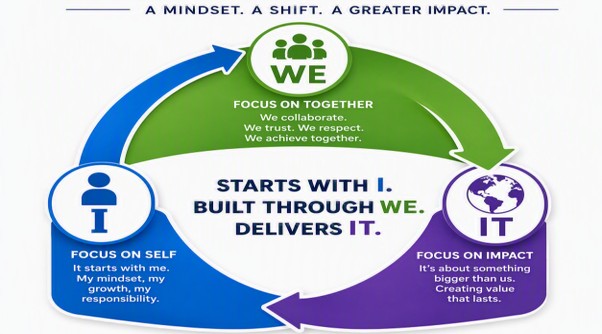
Having the right metrics is vital and if we are committed to building a business fit for the future and the common good – a conscious business – then using the ‘I/We/It’ framework pioneered by Ken Wilber to develop those metrics offers some powerful food for thought. Wilber and many consultants subsequently have used this framework to bring systemic thinking to complex issues.
And the systemic approach is the fundamental principle that needs to be present when we think about metrics. Any chosen metrics need to serve all three constituents (I, We and It) in a holistic and integrated way – in turn this healthily supports and contributes to the meta system within which the business functions.
When we bring attention to supporting the business itself and all its stakeholders to thrive (the ‘I’) we create the conditions in which the ‘We’ can function in a meaningful way – for collaboration to be effective it has to be grounded on the sovereignty of all the members. Sovereignty that is, in itself, balanced and dedicated to genuine thriving rather than winning at all costs. This is how we build the ‘We’.
From the deep principle of collaboration, the business is then able to mobilise the whole business and its system – the partners and stakeholders vital to its future – toward the bigger goal, building impact that supports a thriving humanity and a thriving planet (the ‘It’).
Impact is a powerful word and when we think about directing our efforts and those of all involved in a collaborative venture, being fully mindful of the impacts of our endeavours at every level seems vital. It’s about setting our intention to mobilise for higher order consequences and not just a single-issue focus on the financial impact which so often characterises most business metrics.
As an impact and metrics framework, the ‘I/We/It’ model brings inclusivity, holism and quality. Quality meaning a stretch for a higher order, an ideal model for how to lead and manage a business so that it truly can count itself amongst the responsible and impactful stakeholders on planet earth.